The previous article ended with Homo erectus, a human species that had already changed the shape of our evolutionary story.
By about 1.9 million years ago, Homo erectus had appeared in Africa. It had a body much more like ours than the earlier australopithecines: long legs, shorter arms, and a build suited to walking and traveling over long distances. Over time, populations attributed to Homo erectus spread into parts of western and eastern Asia.
That expansion matters because from this point forward, human evolution was no longer an African story alone.
Different populations became separated across large regions. Some remained in Africa. Others lived in Europe and Asia. Over hundreds of thousands of years, those populations changed, diverged, and sometimes met again.
Eventually, those branches produced Neanderthals, Denisovans, and Homo sapiens.
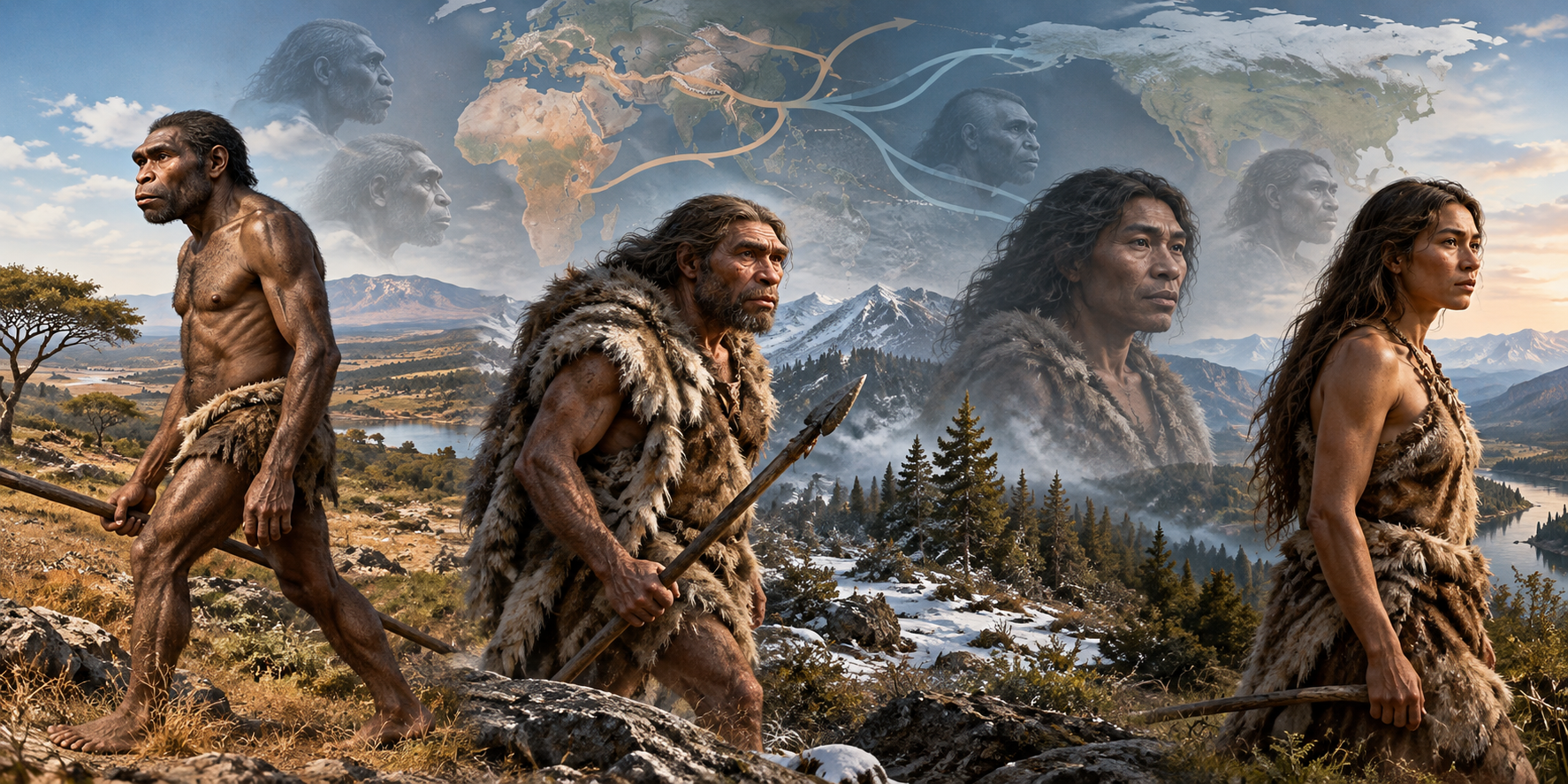
The later human story was not a simple replacement of one species by another. Different populations spread, separated, evolved, met again, and sometimes exchanged genes.
Homo erectus Opens the Door
Homo erectus lived for an extraordinarily long time.
Fossils attributed to the species range from about 1.89 million years ago to roughly 110,000 years ago. Its geographic range included Africa, western Asia, China, and Indonesia.
Early African forms are sometimes called Homo ergaster. Some researchers regard H. ergaster and Asian H. erectus as separate species, while others consider them regional populations of a broadly defined Homo erectus.
That disagreement is worth remembering. Species names are labels scientists place on an incomplete fossil record. The boundaries between ancient populations are not always as sharp as the names make them appear.
What is clearer is that Homo erectus represented an important change.
Its body proportions were much closer to those of modern humans. Acheulean handaxes and other large cutting tools appeared during its time range. Evidence for the controlled use of fire also occurs during this long period, although exactly when regular fire use became widespread remains debated.
Most important for this story, populations of early humans were moving through very different environments across Africa and Eurasia.
Over enough time, geographic separation creates opportunity for populations to diverge.
The Middle of the Story Is Complicated
It would be convenient if we could draw a simple line:
Homo erectus → Neanderthals → Homo sapiens
But the evidence does not support that.
Populations descended from earlier Homo became increasingly diverse during the Middle Pleistocene. Fossils from this period are often difficult to classify, and names such as Homo heidelbergensis have been used differently by different researchers.
Some fossils may represent populations close to the ancestry of Neanderthals. Others may lie closer to the ancestry of Homo sapiens. Still others may belong to branches that left no surviving descendants.
This part of the tree remains one of the areas where classification is actively debated.
What genetics has made increasingly clear, however, is that the Neanderthal, Denisovan, and modern human lineages were already separating hundreds of thousands of years ago.
Neanderthals Were a Human Branch, Not a Failed Version of Us
Neanderthals lived across Europe and western Asia.
They are often portrayed as crude or primitive, but the evidence does not justify that old stereotype.
They were powerfully built humans adapted to demanding environments. They made sophisticated stone tools, hunted large animals, used fire, and cared for injured members of their groups. There is also evidence for symbolic behavior in at least some Neanderthal populations, although the extent and meaning of that behavior continue to be debated.
Genetic and fossil evidence indicate that the line leading to Neanderthals and the line leading to Homo sapiens separated from a common ancestral population hundreds of thousands of years ago.
Fossils from Sima de los Huesos in Spain, about 430,000 years old, already carry DNA associated with the Neanderthal lineage.
That tells us that the separation was well underway by that time.
Neanderthals survived until about 40,000 years ago.
For a significant period near the end of their existence, they shared parts of western Asia and Europe with Homo sapiens.
And they did more than simply encounter one another.
They interbred.
DNA Changed the Story
For many years, scientists debated whether Neanderthals were direct ancestors of modern Europeans, a separate species that was completely replaced by modern humans, or something in between.
Ancient DNA transformed that argument.
When the Neanderthal genome was reconstructed, researchers found that living people outside Africa inherited part of their DNA from Neanderthals.
Depending on the population and how it is measured, people of Eurasian ancestry typically carry roughly 1 to 4 percent Neanderthal-derived DNA in the variable portions of their genomes.
That does not mean any living person is “part Neanderthal” in a simple genealogical sense. The inherited segments are scattered across the genome and reflect interbreeding that occurred tens of thousands of years ago.
But the larger conclusion is unavoidable:
Neanderthals did not disappear without leaving descendants. Some of their genes survive in living humans.
The relationship was also not one-way. Genetic evidence indicates that early Homo sapiens contributed DNA to Neanderthal populations as well.
The branches of the human tree could separate, meet again, and exchange genes.
That is very different from the older picture of isolated species replacing one another cleanly.
Denisovans: A Human Population Discovered Through DNA
The Denisovans made the story even more surprising.
Unlike Neanderthals, Denisovans were not first recognized because researchers found a distinctive skull or skeleton.
They were identified largely through ancient DNA.
A small finger bone found in Denisova Cave in Siberia produced genetic material that did not belong to either a Neanderthal or a modern human. It represented another branch of the human family.
That discovery was remarkable because it showed that genetics could reveal an ancient human population even when the fossil evidence was extremely limited.
Denisovan fossils remain rare, which means we know far less about their physical appearance than we do about Neanderthals.
Their genetic story, however, is substantial.
Denisovans were closely related to Neanderthals, but the two populations had already diverged from one another by hundreds of thousands of years ago.
DNA recovered from Denisova Cave indicates that Denisovans occupied the site by around 250,000 years ago, with Neanderthals appearing there later.
The two populations also interbred.
One extraordinary fossil individual from Denisova Cave had a Neanderthal mother and a Denisovan father.
This was not a theoretical possibility. It was a first-generation child of two human populations that scientists had once imagined as separate branches.
Denisovan DNA Still Lives in Modern People
Denisovans also interbred with Homo sapiens.
Some living populations, particularly in Oceania and parts of Southeast Asia, carry significant Denisovan ancestry. In some populations, Denisovan-derived DNA can account for several percent of the variable genome.
This inheritance was not merely genetic debris.
Some ancient DNA appears to have been useful.
One well-known example involves populations living at high altitude in Tibet. A version of the EPAS1 gene associated with adaptation to low-oxygen environments appears to have entered modern human populations through Denisovan-related ancestry.
That is an important reminder of what interbreeding could mean.
When different human populations met, gene flow sometimes introduced traits that helped later populations survive in particular environments.
Evolution did not always invent an adaptation from scratch. Sometimes populations acquired useful genetic variation from relatives they encountered.
Homo sapiens Appears in Africa
While Neanderthals and Denisovans were developing across Eurasia, another human lineage was evolving in Africa.
That lineage was ours.
The oldest fossils widely attributed to Homo sapiens are about 300,000 years old.
Fossils from Jebel Irhoud in Morocco helped change the older idea that our species appeared suddenly in one small part of eastern Africa.
Instead, the emerging picture suggests that early Homo sapiens populations were spread across different parts of Africa and may have exchanged genes and cultural innovations over a long period.
Our species did not appear all at once with every modern trait already in place.
Early Homo sapiens fossils contain mixtures of archaic and modern characteristics. Faces became increasingly modern before the shape of the braincase reached the form common today.
Like the rest of human evolution, our origin appears to have been a process rather than a single moment.
Leaving Africa Was Not One Journey
The phrase “Out of Africa” can sound as though one population left Africa once and then simply spread across the world.
Reality was more complicated.
There were likely multiple movements out of Africa at different times. Some early expansions apparently left little or no ancestry in living people.
The major expansion that contributed most of the ancestry of present-day non-African populations occurred much later, probably within roughly the last 70,000 years.
As those populations moved into western Asia, they encountered Neanderthals.
Farther east, they encountered Denisovan-related populations.
The genetic evidence tells us that these meetings sometimes resulted in children.
So the expansion of Homo sapiens was not simply a story of replacement.
It also involved mixture.
Why Did Homo sapiens Survive?
By around 40,000 years ago, Neanderthals were gone.
Denisovans also eventually disappeared as a distinct population.
Other human groups vanished as well.
Only Homo sapiens remained.
Why?
There is no single proven answer.
Climate change almost certainly affected the environments in which these populations lived. Population size may have mattered. Small, scattered groups are more vulnerable to local disasters and demographic collapse.
Modern humans may also have had wider social networks, allowing information, materials, and mates to move across larger distances.
Technology, diet, mobility, and communication may all have contributed.
Competition between human populations may have played a role as well.
But it would be misleading to imagine a simple contest in which one “superior” species defeated all the others.
The disappearance of Neanderthals and Denisovans probably resulted from several forces acting together.
And because interbreeding occurred, extinction does not necessarily mean complete biological disappearance.
Part of those populations was absorbed into expanding Homo sapiens groups.
We Are the Last Branch, Not the Only Important One
Today every living human belongs to one species: Homo sapiens.
That makes the present unusual.
For much of the history of our genus, multiple human populations existed at the same time.
Homo erectus occupied parts of Africa and Asia.
Neanderthals lived across Europe and western Asia.
Denisovans and related populations occupied parts of Asia.
Early Homo sapiens developed in Africa and eventually expanded beyond it.
Those populations were distinct enough to develop their own evolutionary histories, yet close enough that at least some of them could still interbreed.
The human family tree therefore looks less like separate branches that never touch and more like a branching river system in which channels sometimes divide and later reconnect.
What Ancient DNA Has Taught Us
The fossil record gave us the bones of this story.
DNA changed its shape.
Ancient genomes demonstrated that Neanderthals contributed ancestry to living humans.
They revealed Denisovans, a population that would have been almost invisible from fossils alone.
They showed that Neanderthals and Denisovans interbred with one another.
And they demonstrated that the expansion of Homo sapiens involved repeated contact with other human populations rather than complete isolation.
There will almost certainly be more surprises.
Denisovans are still represented by remarkably few fossils. Large parts of Africa and Asia remain poorly sampled. DNA rarely survives in warm climates, which leaves major gaps in our genetic record.
Future discoveries may reveal populations we do not yet know existed.
The Long Human Journey
The path from Homo erectus to the modern world was not a straight march toward us.
It was a long period of migration, isolation, adaptation, extinction, and reunion.
Neanderthals were not merely creatures waiting to be replaced.
Denisovans were not an obscure footnote.
And Homo sapiens did not travel through an empty world.
Our ancestors entered landscapes already occupied by other humans.
Sometimes those groups competed.
Sometimes they probably avoided one another.
And sometimes they had children together.
Today only one human species survives, but our DNA still carries evidence of some of those encounters.
The other branches are gone as independent populations.
They are not entirely gone from us.
Sources
- Smithsonian Human Origins Program — Homo erectus
- Smithsonian Human Origins Program — Homo neanderthalensis
- Smithsonian Human Origins Program — Ancient DNA and Neanderthals
- Smithsonian Human Origins Program — DNA and the First Neanderthals
- Smithsonian Human Origins Program — Ancient DNA Reveals the History of Denisova Cave
- Smithsonian Human Origins Program — Differences Found Between Fossil and Modern Human Genomes
- Smithsonian Human Origins Program — Homo sapiens
- Smithsonian Human Origins Program — Our Species Arose at Least 300,000 Years Ago