For many years, human evolution was commonly pictured as a fairly simple progression: one ancient form gradually becoming another until modern humans appeared.
That picture was useful, but it was too simple.
Today, the fossil record looks much more like a branching tree than a ladder. Different hominin species appeared, overlapped, disappeared, and sometimes lived in the same regions at roughly the same time. In some periods, several distinct human relatives may have been sharing Africa together.
The important thing is not to imagine a parade marching from ape to human. Evolution does not work that way.
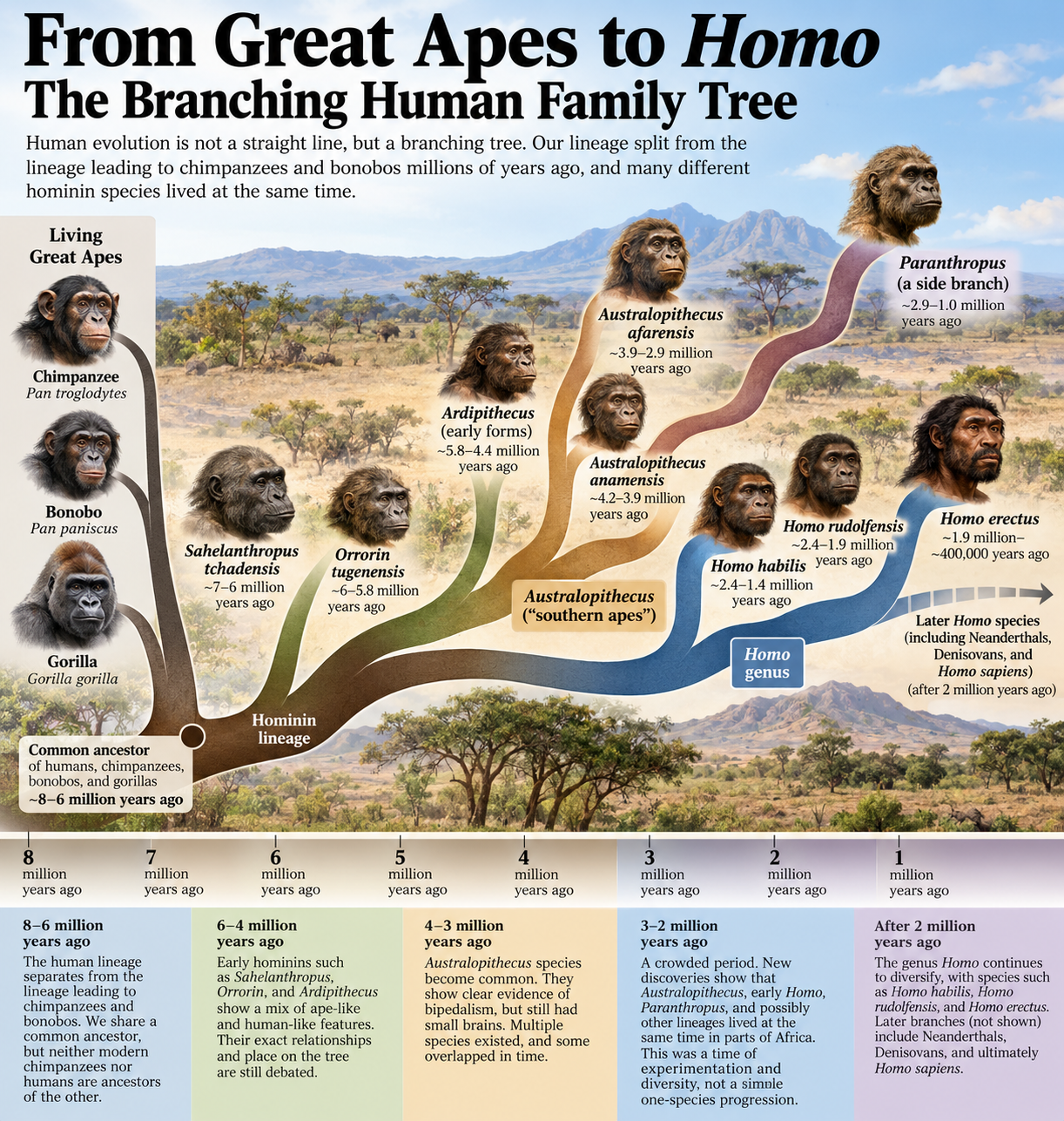
The human family tree is best understood as a set of branching and overlapping lineages rather than a straight progression. Some of the exact relationships shown in any reconstruction remain uncertain and may change as new fossils are discovered.
Humans Are Still Great Apes
Humans did not descend from chimpanzees, gorillas, or any other ape living today.
Humans, chimpanzees, bonobos, and gorillas belong to the larger great ape group. Our lineage and the lineage leading to modern chimpanzees and bonobos separated from a shared ancestor roughly 8 to 6 million years ago.
Neither modern humans nor modern chimpanzees are the ancestor of the other.
That common ancestor has not been identified with certainty.
This is where the human story begins to become difficult.
The Earliest Possible Members of the Human Branch
Some of the oldest fossils proposed as members of the human lineage come from around the time of that evolutionary split.
One of the best known is Sahelanthropus tchadensis, which lived roughly 7 to 6 million years ago in what is now Chad. Its skull has features that have led many researchers to place it near the base of the human family tree.
But this is also a good example of why early human evolution should not be presented as settled fact.
The interpretation of Sahelanthropus has been debated. Some anatomical evidence has been interpreted as consistent with upright walking, while questions remain about its normal form of locomotion and exactly where it belongs on the tree.
That leaves several possibilities. It may represent an early member of the human lineage, it may lie very close to the human-chimpanzee split, or its relationship to later hominins may prove more complicated than a simple ancestor-and-descendant sequence.
Other early forms, including Orrorin and Ardipithecus, add more pieces to the puzzle, but none gives us a clean, unquestioned chain of descent.
That uncertainty is important. The farther back we go, the fewer fossils we have.
Australopithecus Becomes a Major Part of the Story
By around 4 million years ago, the fossil record becomes richer.
Species of Australopithecus appear across parts of Africa. These hominins walked upright but retained a combination of traits that would look both familiar and very different to us.
One of the best known is Australopithecus afarensis, the species associated with the famous fossil known as Lucy.
For many years, species such as A. afarensis were often presented almost as steps in a direct sequence toward Homo.
That interpretation is now treated much more cautiously.
Some australopithecine species overlapped in time. Some may have contributed to later lineages. Others may have represented evolutionary side branches.
The fossil record does not currently allow us to draw a single certain line from one named species directly to the next.
A Crowded Period in Human Evolution
The period between about 3 million and 2.5 million years ago is especially important.
Recent discoveries in Ethiopia have reinforced the idea that several different hominin lineages existed at the same time.
Fossils from Ledi-Geraru include early Homo at about 2.78 million years ago and Australopithecus at about 2.63 million years ago. Researchers concluded that these two lineages coexisted in the Afar region.
Looking more broadly across eastern Africa, the fossil evidence indicates that as many as four hominin lineages may have been present between roughly 3.0 and 2.5 million years ago.
These included forms assigned to:
- early Homo
- Australopithecus
- Paranthropus
- and perhaps other closely related populations
A recently described Paranthropus jaw from the Afar, dated to between about 2.5 and 2.9 million years ago, has added another complication. It extends the known geographic range of that genus and reinforces just how incomplete our picture of this period remains.
That is a very different picture from the old idea of one species simply replacing another.
It suggests an evolutionary landscape in which several experiments in body shape, diet, locomotion, and survival were occurring at once.
When Did the Genus Homo Begin?
This is one of the most important questions in the entire subject, and the answer is still not perfectly clean.
The oldest widely accepted fossil evidence assigned to the genus Homo comes from Ethiopia and dates to about 2.8 million years ago.
The Ledi-Geraru mandible known as LD 350-1 shows a mixture of more primitive features and characteristics associated with later members of Homo. More recent fossils from the same region have strengthened the evidence that Homo was present there by about 2.78 million years ago.
So a careful way to state it is:
The genus Homo was present by about 2.8 million years ago, but exactly which earlier population gave rise to it remains uncertain.
That distinction matters.
We can identify increasingly Homo-like fossils, but we cannot yet point confidently to one species and say, “This was the direct ancestor of all later humans.”
Homo Itself Was Not a Straight Line
Once Homo appears, the tree does not become simpler.
Species such as Homo habilis, Homo rudolfensis, and eventually Homo erectus appear in the fossil record.
These forms do not line up neatly one after another.
Some overlap in time. Their exact relationships are still debated, and researchers do not always agree about whether particular fossils represent separate species or variation within one species.
By about 1.9 million years ago, Homo erectus appears.
That species is especially important because it had body proportions much more similar to modern humans, including relatively long legs and shorter arms compared with earlier hominins.
Homo erectus also became extraordinarily successful. Fossils attributed to the species are known from Africa and parts of Asia, and it is generally regarded as the first early human species to expand far beyond Africa.
At the beginning of its known time range, Homo erectus overlapped in East Africa with other early human species including Homo habilis, Homo rudolfensis, and Paranthropus boisei.
Even within Homo erectus itself there is disagreement. Some researchers separate African fossils into Homo ergaster, while others regard them as part of a geographically variable Homo erectus.
That is where this part of the story can reasonably stop.
The later history of Homo erectus, migration beyond Africa, Neanderthals, Denisovans, and eventually Homo sapiens deserves its own article.
A Tree, Not a Ladder
The most important change in our understanding of human evolution is not simply that more species have been discovered.
It is that the shape of the story has changed.
Instead of:
one species → another species → another species → us
the evidence increasingly looks like:
many branches, some overlapping, some ending, and a few contributing to later populations.
At several points in prehistory, our ancestors were not the only human-like beings alive.
Today, Homo sapiens is the only surviving human species.
For much of the past, that appears to have been the exception rather than the rule.
What We Know, and What We Still Do Not
Some parts of this story are supported by strong evidence.
We know humans are part of the great ape family. That conclusion is supported by both anatomy and genetics. Humans share the basic skeletal and anatomical pattern of the great apes, and DNA sequencing places us most closely with chimpanzees and bonobos, then gorillas, with orangutans more distant. Depending on how genomic differences are counted, humans and chimpanzees differ by roughly 1.2% in shared DNA sequences, with additional differences from insertions, deletions, and duplications. The overall pattern is what matters: human DNA consistently nests our species within the great ape branch rather than outside it.
This does not mean humans descended from chimpanzees. Both lineages descended from an older common ancestor, probably between about 8 and 6 million years ago.
We know several hominin lineages overlapped. And we have fossil evidence for Homo by about 2.8 million years ago.
Other questions remain unsettled.
We do not know exactly what the last common ancestor of humans and chimpanzees looked like.
We do not know whether every proposed early hominin truly belongs on the human branch.
We do not know exactly which australopithecine population gave rise to Homo.
And we should expect the tree to change again.
That is not a weakness in the science. It is what happens when new fossils, better dating methods, and new ways of analyzing anatomy add evidence to a story that began millions of years ago.
Sources
- Smithsonian Human Origins Program — Introduction to Human Evolution
- Smithsonian Human Origins Program — Genetics
- Smithsonian Human Origins Program — Sahelanthropus tchadensis
- Smithsonian Human Origins Program — Early Human Species
- Smithsonian Human Origins Program — Homo erectus
- Villmoare, B. et al. — New discoveries of Australopithecus and Homo from Ledi-Geraru, Ethiopia, Nature
- Afar fossil shows broad distribution and versatility of Paranthropus, Nature